
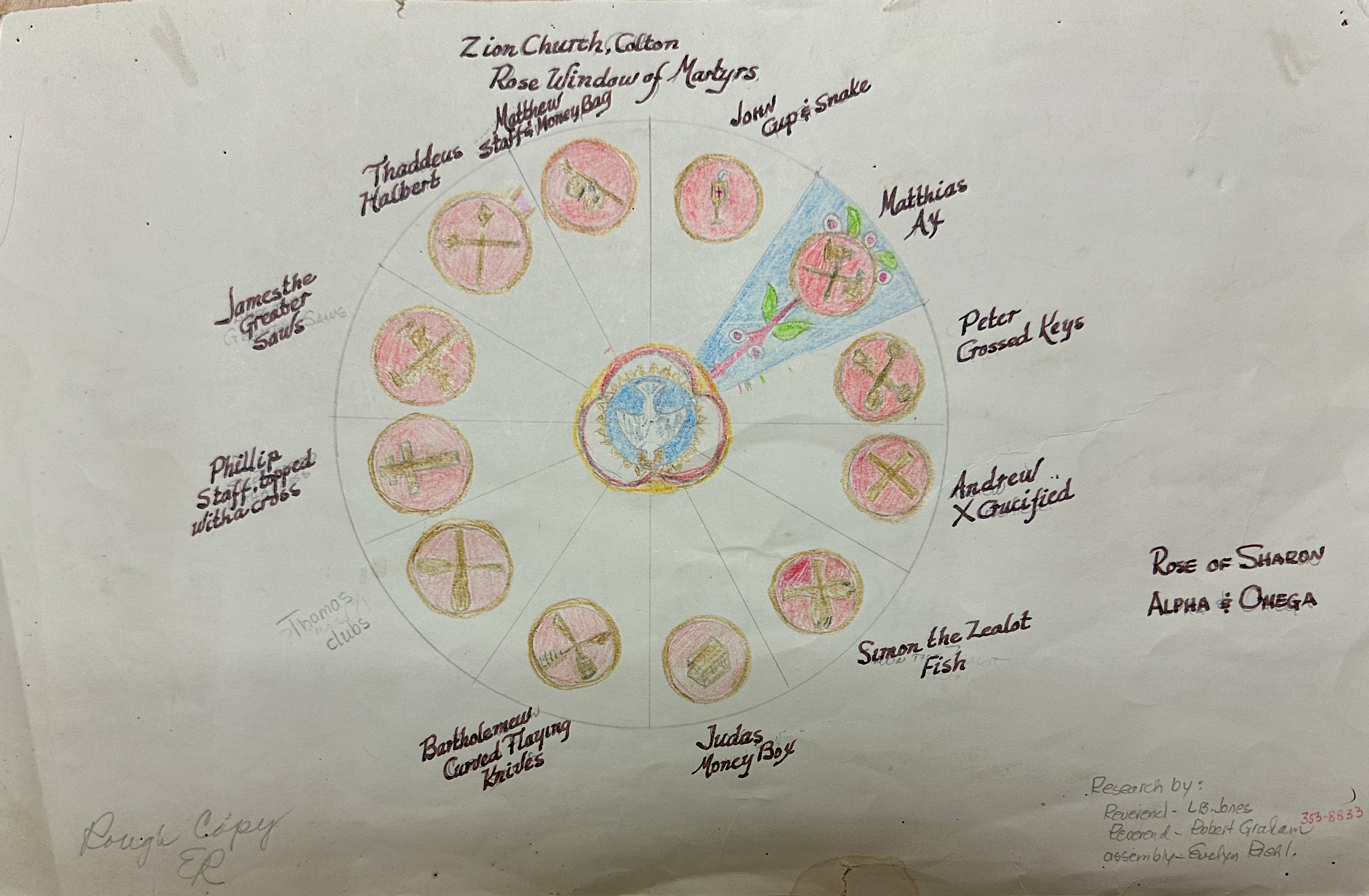
Ten feet in diameter, framed by a single hand carved piece of sandstone the Tiffany Rose Window celebrates twelve Christian martyrs.
St. John – Cup and Snake
The tradition of Saint John the Evangelist and the chalice with a snake originates from a Christian legend. According to this story, while Saint John was in Ephesus, he was offered a cup of poisoned wine by his enemies. Before drinking, he blessed the cup, and the poison miraculously emerged in the form of a serpent, leaving the wine harmless. John then drank the wine without suffering any ill effects
St. Matthias – Ax
The tradition of Saint Matthias being depicted with an axe is linked to the manner of his martyrdom. According to various accounts, Matthias was stoned and then beheaded with an axe, which became a symbol associated with him in Christian iconography. This representation signifies his martyrdom and unwavering faith in the face of persecution. Saint Matthias was chosen to replace Judas Iscariot as one of the twelve apostles after Judas’s betrayal and death.
St. Peter – Crossed Keys
The symbol of Saint Peter with crossed keys originates from Jesus’ words in Matthew 16:19: “I will give you the keys of the kingdom of heaven; whatever you bind on earth shall be bound in heaven, and whatever you loose on earth shall be loosed in heaven.” The crossed keys represent the authority granted to Peter by Christ, signifying his role as the leader of the apostles, as well as his stewardship over the Church.
St. Andrew – Cross
The tradition of Saint Andrew being associated with an X-shaped cross, known as the St. Andrew’s Cross or crux decussata, stems from Christian legend surrounding his martyrdom. According to tradition, Andrew was crucified in Patras, Greece, around AD 60. He requested to be crucified on a cross different from the one on which Jesus died, believing himself unworthy to die in the same manner as his Lord. As a result, he was executed on a diagonal or X-shaped cross.
St. Simon the Zealot – Crossed Fish
The symbol of two crossed fish associated with Saint Simon the Zealot in a rose window reflects his role as a “fisher of men” through his evangelistic work. This imagery emphasizes his success in spreading the Gospel and converting people to Christianity. The crossed fish symbolize unity and the mission of bringing souls to Christ, a metaphor rooted in Jesus’ call to His disciples to become “fishers of men” (Matthew 4:19).
Judas Iscariot – Money box
The symbol of the money box associated with Judas Iscariot originates from his role as the treasurer among Jesus’ disciples. According to the Gospel of John, Judas was entrusted with the group’s money box (glōssokomon), which he managed but also misused by stealing from it (John 12:6). This symbol reflects his betrayal of trust and his greed, which ultimately led to his infamous act of betraying Jesus for thirty pieces of silver (Matthew 26:15).
St. Bartholemew – Curved Flaying Knives
The curved flaying knives associated with Saint Bartholomew symbolize the instruments of his martyrdom, as he was famously flayed alive before being beheaded. These knives are a prominent feature in Christian art and iconography, often depicted alongside Bartholomew to represent his suffering and ultimate sacrifice for his faith. Bartholomew is also frequently shown holding one of these knives alongside his own flayed skin, as seen in famous works like Michelangelo’s Last Judgment.
St. Thomas – Clubs
The symbol of crossed clubs associated with Saint Thomas the Apostle reflects the traditional account of his martyrdom. According to Christian tradition, Thomas was martyred in India, where he had traveled to preach the Gospel. He was reportedly killed by being struck with clubs or spears, and the crossed clubs symbolize the instruments of his death.
St. Phillip: Staff tipped with a cross
The symbol of Saint Philip with a staff tipped with a cross signifies his missionary work and his dedication to spreading the Gospel. The Tau cross, in particular, is a T-shaped cross that has been associated with Saint Philip in Christian iconography and represents his faith and ultimate sacrifice. Tradition holds that Philip was martyred in Hierapolis (modern-day Turkey), where he was crucified upside down or beheaded.
St. Thaddeus – Halbert
The halberd associated with Saint Jude Thaddeus symbolizes the instrument of his martyrdom. According to tradition, Jude was martyred in Persia, where he was killed with a halberd or similar weapon.
St. James the Less
The label on the drawing associates the saws with James the Greater (son of Zebedee, St. John’s brother). However, the saws, as an iconic symbol in apostolic rose windows or Christian art, is most closely associated with James the Less (also called James the Younger or James the son of Alphaeus). Tradition holds that James the Less was martyred by being sawn in half, which is why the saw became his emblem. The saw may also symbolize James’ work as a carpenter.
St. Matthew – Staff and money bag
Saint Matthew is often depicted with a staff and money bag, symbolizing his former profession as a tax collector before following Jesus. The staff represents his missionary journey, while the money bag highlights his past life of handling finances, which he abandoned to embrace a spiritual calling. These symbols emphasize his transformation from material wealth to serving Christ.
Missing – St. James the Greater
Saint James the Greater (son of Zebedee, St. John’s brother) is not included in the Rose Window. By including Judas Iscariot as well as St. Matthias (who replaced Judas), the Rose Window reaches the number twelve. Therefore, one of the original twelve disciples has been omitted.
According to historical and religious sources, St. James the Greater was martyred by beheading under King Herod Agrippa I. His usual symbols are the pilgrim’s staff and scallop shell, reflecting his role as the patron of pilgrims and his legendary journey to Spain.
Research done by the Rev. Lawrence B. Jones, Rev. Robert L. Graham, updated by Richard Bradshaw
 Zion Episcopal Church